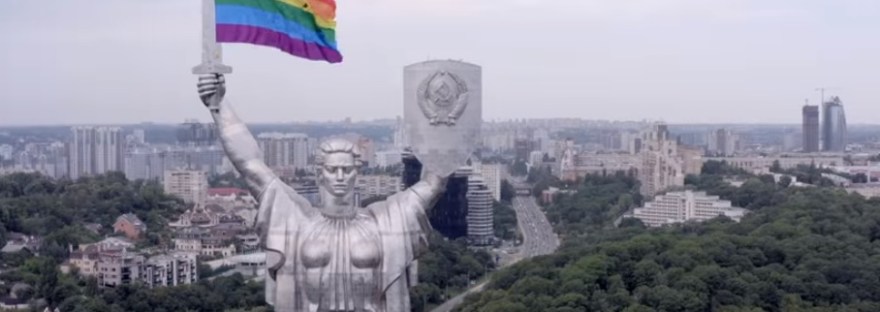
On June 21, 2020, a Ukrainian NGO KyivPride, that for several years already has been the main organizer of the Pride week and Equality march in Kyiv, posted a video in which a drone carrying a large rainbow flag flew over various districts of the Ukrainian capital. The flag ended up placed on top of the Motherland Monument, a Soviet-era war memorial in Kyiv. The monument is a large steel statue of a symbolic mother holding a sword and shield. The drone flew in front of the sword so that on the video, it looked as if the mother was waving a flag.
As in many places across the world, Pride month in Ukraine was moved to an online format forcing the organizing committee to be extremely creative. For more than a week, Ukrainian activists hosted zoom-conferences and interview marathons as Ukrainian cities were under strict COVID 19 lockdown. Despite screen fatigue, online events had quite decent attendance. As everybody was talking from the comfort of their own rooms and flats, it was the first time that none of the Pride Month events were disrupted by conservative right-wing groups’. The safety and accessibility of online meetings also allowed for the participation of people who could not make it previously due to health conditions or not being able to afford it. For example, a Ukraine-based NGO I am working with, Parents’ Initiative TERGO, for the first time in seven years of its existence hosted a series of online meetings of parents of LGBTQ people. Bringing together parents and activists from Ukraine, Russia, Belarus, Moldova, Kyrgyzstan, Latvia, and Lithuania. Of course, in theory, it could have been done before COVID, too. Still, it took a pandemic to push people to finally overcome their fear of technology and learn how to use online communication tools.
Read more



 Maryna Shevtsova